When a parent starts thinking about downsizing and “what next?”, adult children are often the ones quietly holding everything together…. listening to worries, researching options and trying to balance safety, independence and finances in a way that feels fair to everyone.
At Castle View, we recognise that this isn’t always straightforward……
Whether your parents are simply curious about retirement living or facing an urgent change, it can feel like a lot to carry. You may be:
Worried about their safety, loneliness or the upkeep of a house that no longer fits.
Unsure how to raise the subject of moving without sounding pushy.
Trying to understand fees, contracts and care options while also juggling your own life.
Our team speak to adult sons and daughters every day. We’re here to offer clear information, space to ask questions and a calm, neutral perspective – not pressure.
Sometimes Castle View is the right choice; sometimes it isn’t. Either way, you are welcome to talk things through with us.
Many families tell us that, before discovering Castle View, they thought their only choices were: stay in the family home with increasing worry, or move straight to a care home. Independent retirement living at Castle View offers a different path.
At Castle View your parent has:
Their own self‑contained apartment, with kitchen, living space and balcony or terrace.
Step‑free access, lifts to all floors and modern safety features designed for later life.
24/7 staff on site, secure entry and alarm systems for rapid assistance in an emergency.
A restaurant, lounges, roof terrace and social spaces they can use as much or as little as they like.
For many children, this strikes the right balance: parents remain independent and “at home”, while you gain peace of mind that they are not alone and can get help if needed.
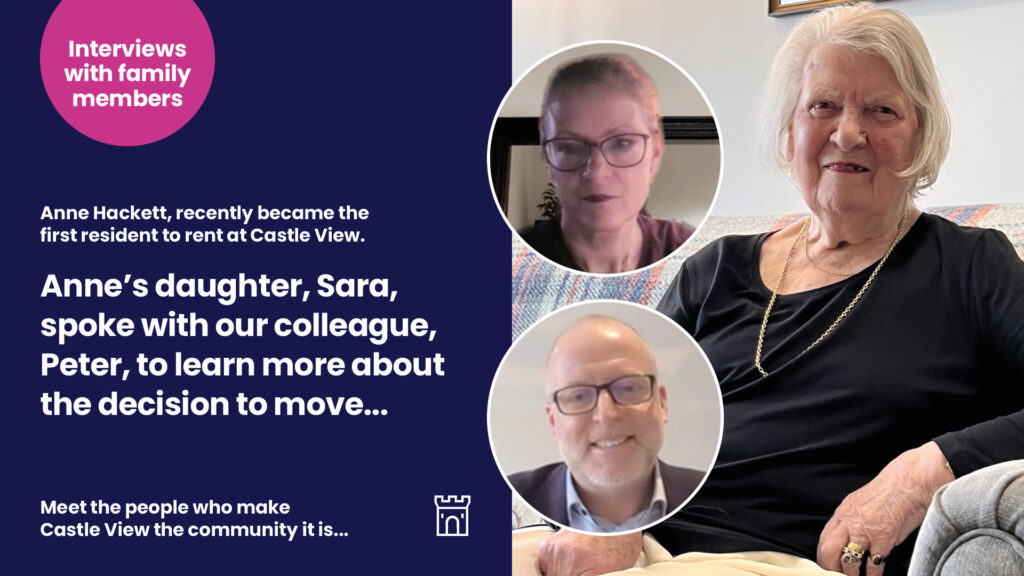
Behind every decision to move into Castle View is a family story. Sara, daughter of our first rental resident, speaks very openly about what this journey was like for her and her mum.
Her mum’s previous home needed significant work to be safe and manageable as she grew older. The thought of future loneliness there was already weighing on her, but the idea of anything that sounded like a ‘care home’ felt too extreme.
Since moving, Sara has seen a real change in her mum: more social contact, more confidence and a sense that some of the mental ‘spark’ has returned. In her own words, the move has “taken years off her”, and their relationship has shifted from worry and persuasion back to enjoying time together as mother and daughter.
When Sue’s father died, her mum’s world became much quieter. Everyday life in the family home began to feel overwhelming and lonely, even though she was still physically able to cope.
Sue talks about that delicate balance between being ‘bad cop’ – the one raising difficult questions – and, eventually, being seen as the person who helped her mum reclaim a full life.
In our interview, Sue reflects on the difference it made to see real apartments, meet homeowners and experience the atmosphere herself. What reassured her most was that her mum now has people around her, staff keeping an eye out, and a community on her doorstep….while still having her own front door, privacy and routines.
We know that emotional support is only half the story. The practical side of a move can also feel daunting, especially if your parents have lived in the same home for decades.
That’s why Castle View offers:
Clear explanations of our costs, contracts and services, with written details you can review together.
Access to a regulated care partner (Great Park Homecare) for those who may later need a little extra day‑to‑day help, from personal care to medication prompts.
Additional support services for things like laundry, housekeeping and help with errands, so support can build up gently over time.
A partnership with The Senior Move Partnership for those who’d value specialist help sorting, downsizing and planning the move itself.
We always encourage families to seek independent financial and legal advice so that any move fits into your parents’ wider plans, including inheritance and long‑term care.
Every family works differently. Some parents want to explore Castle View alongside their children from the start; others prefer to visit alone first so they can form their own view. Both approaches are welcome.
You might choose to:
Book a joint tour to see apartments, communal areas and the local neighbourhood, followed by a coffee or lunch on site.
Come on your own initially to ask detailed questions about fees, care and contracts, then return later with your parents once you feel confident in the facts.
Attend one of our open days or events to get a feel for the community and talk informally with residents and team members.
Our role is to answer questions honestly, share what life at Castle View is really like and give you time to think things through together.
Our approach at Castle View is about giving you space:
Space to ask the questions you might not want to put straight to your parents yet.
Space to understand what independent retirement living can and cannot offer.
Space to decide, together, if and when the time is right.
Sometimes that journey leads to a move to Castle View; sometimes it leads to small changes at home or a decision to wait. We will always respect that outcome.
If you’d like to talk, view our guide for adult children or arrange a visit, our team would be pleased to hear from you.

We're here to answer any questions you may have. Give us a call.
We would love to show you around Castle View Windsor.
We've compiled answers to our most frequently asked questions.

Nicky King
Later Life Advisor
Nicky
As our Later Life Advisor, my job is to help support you as you consider your later life living options’ Please drop me a line and I’ll come straight back to you.
Castle View Windsor
We firmly believe that the internet should be available and accessible to anyone, and are committed to providing a website that is accessible to the widest possible audience, regardless of circumstance and ability.
To fulfill this, we aim to adhere as strictly as possible to the World Wide Web Consortium’s (W3C) Web Content Accessibility Guidelines 2.1 (WCAG 2.1) at the AA level. These guidelines explain how to make web content accessible to people with a wide array of disabilities. Complying with those guidelines helps us ensure that the website is accessible to all people: blind people, people with motor impairments, visual impairment, cognitive disabilities, and more.
This website utilizes various technologies that are meant to make it as accessible as possible at all times. We utilize an accessibility interface that allows persons with specific disabilities to adjust the website’s UI (user interface) and design it to their personal needs.
Additionally, the website utilizes an AI-based application that runs in the background and optimizes its accessibility level constantly. This application remediates the website’s HTML, adapts Its functionality and behavior for screen-readers used by the blind users, and for keyboard functions used by individuals with motor impairments.
If you’ve found a malfunction or have ideas for improvement, we’ll be happy to hear from you. You can reach out to the website’s operators by using the following email
Our website implements the ARIA attributes (Accessible Rich Internet Applications) technique, alongside various different behavioral changes, to ensure blind users visiting with screen-readers are able to read, comprehend, and enjoy the website’s functions. As soon as a user with a screen-reader enters your site, they immediately receive a prompt to enter the Screen-Reader Profile so they can browse and operate your site effectively. Here’s how our website covers some of the most important screen-reader requirements, alongside console screenshots of code examples:
Screen-reader optimization: we run a background process that learns the website’s components from top to bottom, to ensure ongoing compliance even when updating the website. In this process, we provide screen-readers with meaningful data using the ARIA set of attributes. For example, we provide accurate form labels; descriptions for actionable icons (social media icons, search icons, cart icons, etc.); validation guidance for form inputs; element roles such as buttons, menus, modal dialogues (popups), and others. Additionally, the background process scans all the website’s images and provides an accurate and meaningful image-object-recognition-based description as an ALT (alternate text) tag for images that are not described. It will also extract texts that are embedded within the image, using an OCR (optical character recognition) technology. To turn on screen-reader adjustments at any time, users need only to press the Alt+1 keyboard combination. Screen-reader users also get automatic announcements to turn the Screen-reader mode on as soon as they enter the website.
These adjustments are compatible with all popular screen readers, including JAWS and NVDA.
Keyboard navigation optimization: The background process also adjusts the website’s HTML, and adds various behaviors using JavaScript code to make the website operable by the keyboard. This includes the ability to navigate the website using the Tab and Shift+Tab keys, operate dropdowns with the arrow keys, close them with Esc, trigger buttons and links using the Enter key, navigate between radio and checkbox elements using the arrow keys, and fill them in with the Spacebar or Enter key.Additionally, keyboard users will find quick-navigation and content-skip menus, available at any time by clicking Alt+1, or as the first elements of the site while navigating with the keyboard. The background process also handles triggered popups by moving the keyboard focus towards them as soon as they appear, and not allow the focus drift outside it.
Users can also use shortcuts such as “M” (menus), “H” (headings), “F” (forms), “B” (buttons), and “G” (graphics) to jump to specific elements.
We aim to support the widest array of browsers and assistive technologies as possible, so our users can choose the best fitting tools for them, with as few limitations as possible. Therefore, we have worked very hard to be able to support all major systems that comprise over 95% of the user market share including Google Chrome, Mozilla Firefox, Apple Safari, Opera and Microsoft Edge, JAWS and NVDA (screen readers).
Despite our very best efforts to allow anybody to adjust the website to their needs. There may still be pages or sections that are not fully accessible, are in the process of becoming accessible, or are lacking an adequate technological solution to make them accessible. Still, we are continually improving our accessibility, adding, updating and improving its options and features, and developing and adopting new technologies. All this is meant to reach the optimal level of accessibility, following technological advancements. For any assistance, please reach out to


